
Published · DOCSI.AI v0.1 · Ultra-high effort
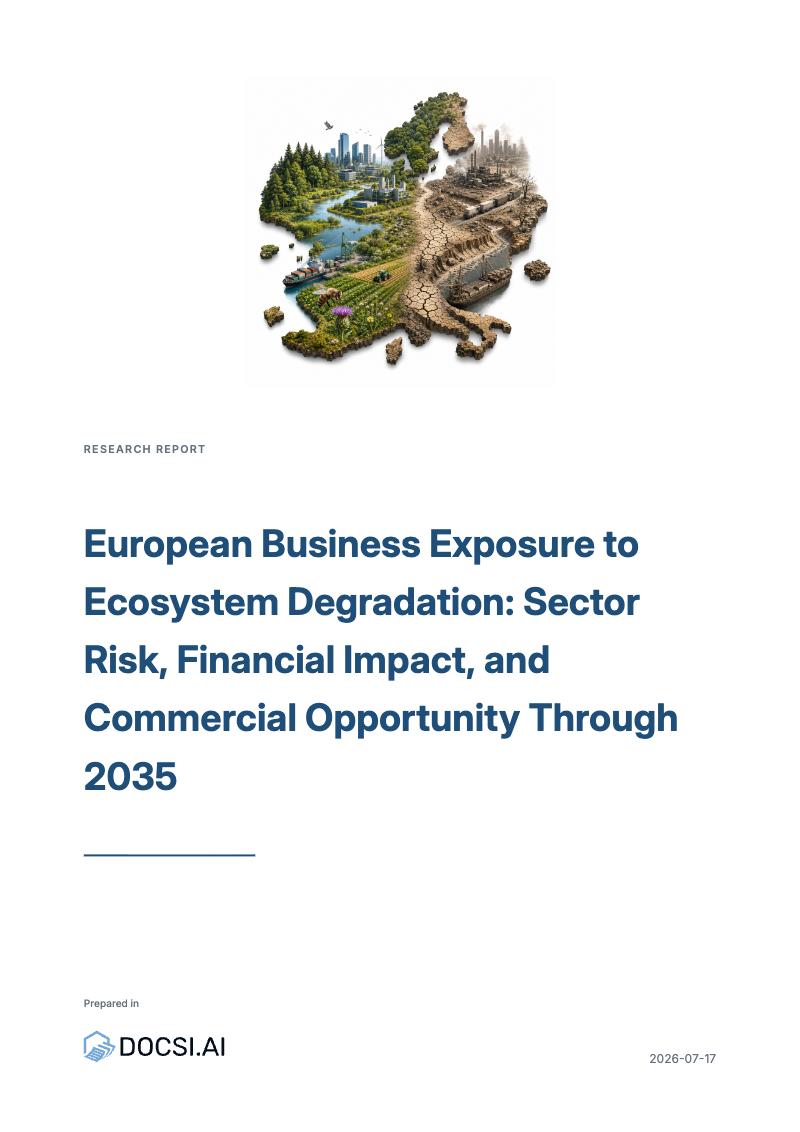
European Business Exposure to Ecosystem Degradation: Sector Risk, Financial Impact, and Commercial Opportunity Through 2035
Prompt used
Research how European businesses depend on natural biological systems such as pollination, soil fertility, freshwater ecosystems, natural pest control, forests, and wetlands. Identify which industries and regions are most exposed to ecosystem degradation, how these risks could affect revenues, costs, insurance, credit, and asset values, and where new commercial opportunities may emerge.
Compared against
The same task run through other AI tools, for a side-by-side comparison.
Review
An objective comparison of the reports above, generated with Gemini by Google.
Comparative Audit of European Business-Location Reports
1. Overall Scorecard
| Rank | Report | Prompt /35 | Depth /20 | Evidence /25 | Actionability /15 | Structure /5 | Audit Score /100 | Overall Value Assessment |
|---|---|---|---|---|---|---|---|---|
| 1 | DOCSI.AI | 23 | 16 | 23 | 12 | 4 | 78 | 8.0/10 |
| 2 | ChatGPT | 15 | 13 | 20 | 10 | 4 | 62 | 6.0/10 |
| 3 | Claude | 12 | 8 | 16 | 7 | 3 | 46 | 4.5/10 |
| 4 | Manus AI | 12 | 6 | 12 | 5 | 3 | 38 | 4.0/10 |
DOCSI.AI holds a decisive advantage over the cohort, driven primarily by its superior performance in Accuracy, Evidence, and Transparency, as well as Analytical Depth. It is the only report to apply a highly structured approach to integrating geographic outcomes with specific corporate operational exposures. ChatGPT captures second place with a clear advantage over the bottom tier, leveraging strong financial translation and reliable macroeconomic data, though it materially neglects several mandated operating models and the 2040 time horizon. Claude and Manus AI lag significantly; both operate at a conceptual or overly narrow level, missing the comprehensive geographic and cross-driver integration demanded by the baseline directive. No identical Overall Value Assessments conceal meaningful Audit Score differences.
2. Executive Overview of the Evaluated Reports
The evaluated cohort collectively struggled to fully satisfy the baseline research directive, particularly regarding the strict 2040 time horizon, demographics, and labor markets. The strongest shared characteristic across the reports is the robust integration of water availability and climate risk into business and financial frameworks. Conversely, the most important shared weakness is the near-total omission of demographics, labor markets, and specific operational location logic for data centers and research centers. The cohort is split between analytical (ChatGPT, DOCSI.AI) and descriptive or narrow (Claude, Manus AI) approaches. None of the reports consistently modeled long-term trajectories specifically through the requested 2040 horizon, generally defaulting to either immediate compliance deadlines or generic end-of-century scenarios.
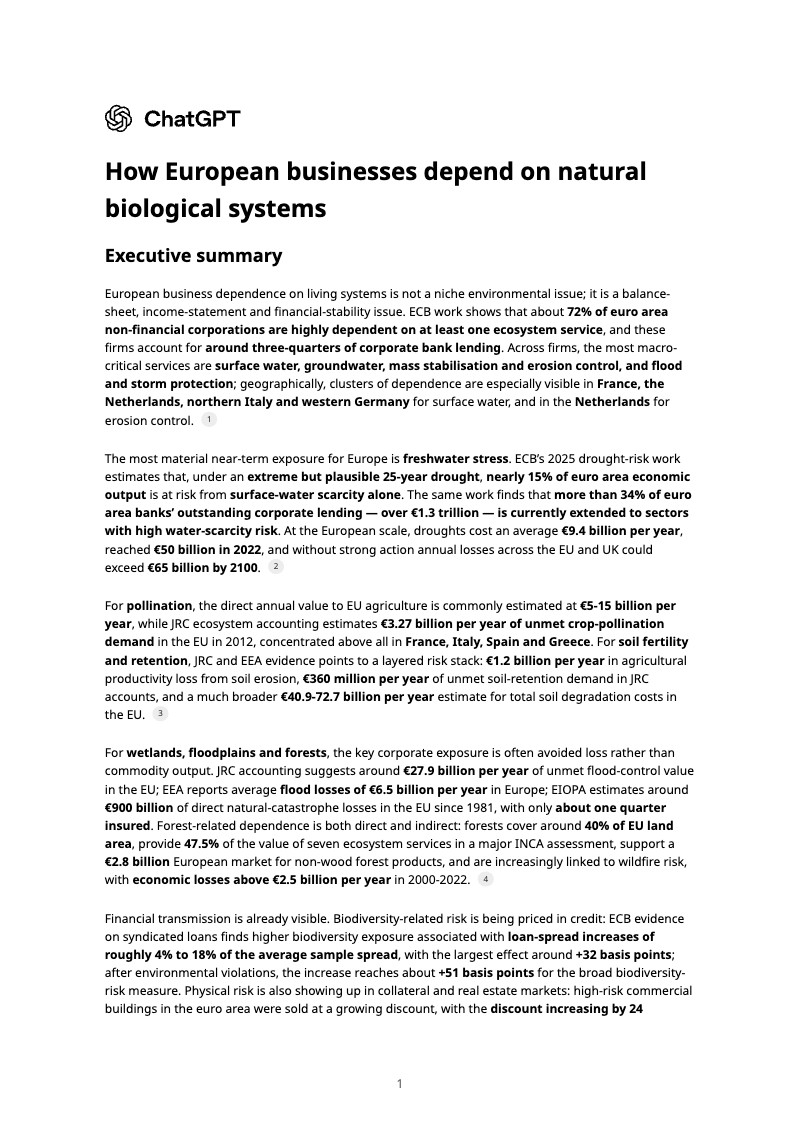
ChatGPT — 6.0/10
ChatGPT relies on a macroeconomic and financial-stability angle, translating physical ecosystem shocks directly into credit and insurance implications. Its strongest contribution is its rigorous translation of water and climate risks into financial metrics (e.g., EBITDA and credit risk), while its largest limitation is its failure to address multiple required drivers (demographics, labor) and operating models. It is best suited for portfolio risk managers and macro-economists.
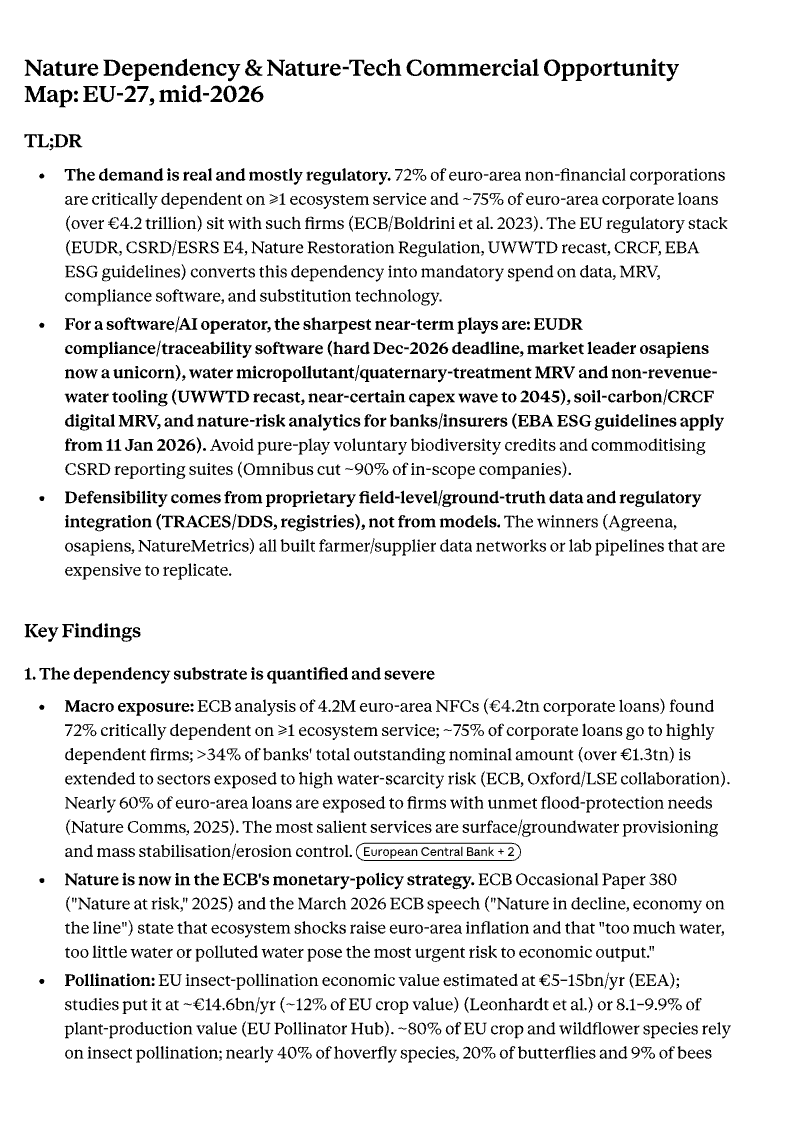
Claude — 4.5/10
Claude adopts a narrow, tech-and-compliance-heavy structural angle, evaluating European ecosystem issues through the lens of software solutions and regulatory frameworks. Its strongest contribution is mapping regulatory compliance deadlines to specific commercial software opportunities, but its largest limitation is its almost complete detachment from geographic site-selection logic and failure to holistically assess regional attractiveness. It is primarily suited for software vendors and regulatory compliance teams.
DOCSI.AI — 8.0/10
DOCSI.AI provides a highly structured, evidence-heavy analytical approach, merging detailed regulatory timelines with granular regional ecosystem stress testing. Its strongest contribution is the explicit pairing of specific industry vulnerabilities with distinct European geographies (e.g., Mediterranean arable agriculture), though its largest limitation is an incomplete treatment of demographic and labor drivers. It serves as a decision-oriented guide for corporate strategists and institutional investors.
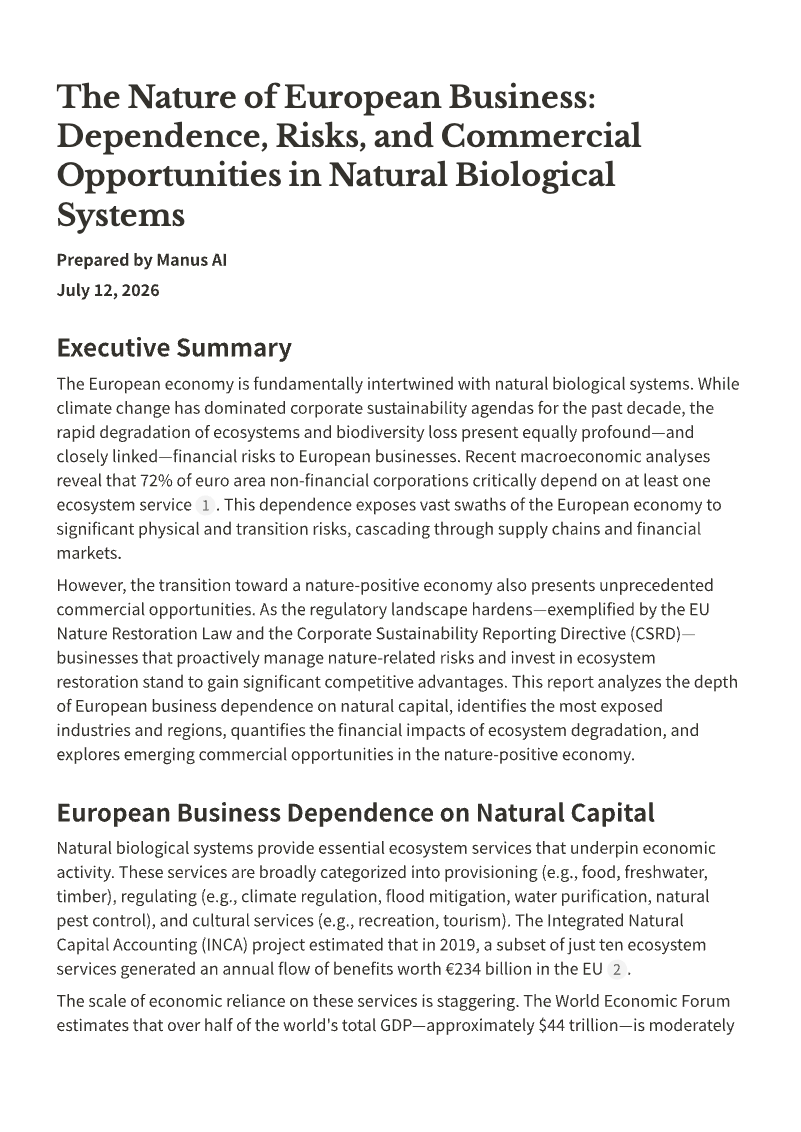
Manus AI — 4.0/10
Manus AI delivers a broad, descriptive overview of natural capital dependence, adopting a generalized and introductory tone. Its strongest contribution is outlining high-level economic reliance on ecosystems, while its largest limitation is a profound lack of geographic granularity, temporal forecasting, and actionable site-selection logic. It is geared toward a generalist or executive reader seeking basic thematic awareness.
3. Granular Comparative Assessment
3.1 Quality, Structure, and Analytical Depth
Causal reasoning and cross-driver integration vary dramatically across the reports. DOCSI.AI establishes clear causal mechanisms, linking multi-process soil degradation and water stress to specific financial penalties for Mediterranean agriculture and utilities. It successfully integrates climate risk, water availability, and insurability, demonstrating how "wetland drainage... directly removes the flood-buffering service that constrains claims frequency" (Section: "Sector-by-Region Exposure Rankings"). ChatGPT also demonstrates robust causal reasoning, mapping physical ecosystem shocks to lower EBITDA, higher probabilities of default, and asset depreciation. However, ChatGPT fails to integrate logistics or labor into these financial models. Claude and Manus AI rely on generalized causal assertions; Claude links regulation to software demand but ignores physical geographic constraints, while Manus AI generically notes that degradation impacts revenues without explaining the transmission mechanisms in depth.
Geographic granularity distinguishes the leaders from the laggards. DOCSI.AI analyzes specific sub-regions, directly comparing the Po Valley, the Iberian Peninsula, and the Baltic states using consistent ecosystem dependency criteria. ChatGPT offers moderate granularity, referencing NUTS3 regions, the Rhine, and the Po basin, but names regions rather than strictly comparing them against a unified framework. Claude lists countries sporadically when discussing software pilots or water stress but provides no structured geographic comparison. Manus AI provides virtually no geographic comparability, relying on broad mentions of the "Mediterranean region".
Operating-model differentiation is a shared weakness. DOCSI.AI separates water-intensive manufacturing, agriculture, and utilities, recognizing unique trade-offs for each. ChatGPT effectively differentiates food processing and heavy manufacturing but ignores data centers and research operations entirely. Claude substitutes the requested operating models with nature-tech commercial models (e.g., SaaS, MRV). Scenario analysis is only meaningfully handled by DOCSI.AI, which outlines distinct upside and downside paths through 2035, and ChatGPT, which incorporates a 25-year drought scenario.
3.2 Accuracy, Transparency, and Data Rigor
Source traceability and authority are the primary separators in this cohort. DOCSI.AI utilizes a highly transparent and traceable methodology, citing specific institutional frameworks (ECB, ENCORE, TNFD, CSRD) and supporting quantitative claims with precise legislative or empirical references (e.g., "€4.3 trillion in euro area corporate loans"). ChatGPT is similarly rigorous, explicitly grounding its claims in ECB, JRC, and EIOPA data, ensuring high source authority for its financial and meteorological metrics. However, ChatGPT sometimes conflates ecosystem-accounting estimates with realized losses, a limitation it appropriately discloses.
Claim-to-source fit is generally strong in DOCSI.AI and ChatGPT, where conclusions do not exceed the provided data. In contrast, Claude relies heavily on tech-sector deal sizes and vendor lists (e.g., osapiens, NatureMetrics) to establish market urgency, but fails to connect these corporate funding rounds to the broader baseline drivers of regional attractiveness. Manus AI draws on credible sources like the ECB and World Economic Forum, but its claims are often too broad to be verified at a regional level, reducing internal analytical consistency.
Temporal and regulatory precision is exceptionally high in DOCSI.AI, which distinguishes enacted legislation (e.g., EU Nature Restoration Law entered into force August 2024) from pending mandates and aligns these with specific compliance years. Claude also demonstrates high regulatory precision regarding software compliance deadlines (e.g., EUDR to 2026). ChatGPT lacks precise forecast precision toward the 2040 horizon, relying instead on generic long-term statements or 2100 projections. Uncertainty disclosure is present in ChatGPT, which explicitly cautions about data gaps in natural pest control, and DOCSI.AI, which notes where valuation proxies must substitute for clean transaction data. Manus AI provides no meaningful disclosure of data limitations or uncertainty.
3.3 Value and Actionability
Value and actionability segment strictly by the intended audience. For corporate strategy teams and investment committees, DOCSI.AI is the definitive leader. It provides explicit decision frameworks, linking TNFD LEAP methodologies to asset-level underwriting, and offers a highly actionable shortlisting utility by mapping specific sectors to Tier 1 through Tier 4 geographic risk zones. Its financial translation is excellent, converting ecosystem degradation into capital expenditure surges and uninsurable risks.
ChatGPT provides high utility for portfolio managers and risk teams by translating ecosystem deficits into credit spreads, probability of default (PD), and loss given default (LGD) metrics. However, it lacks a technical site-selection framework for operators, meaning real estate or manufacturing planners cannot easily use it to evaluate a new specific facility location.
Claude offers unique, highly specific actionability for legal, compliance, and IT procurement teams. By focusing on EUDR traceability software and UWWTD MRV tech, it provides implementation guidance for regulatory substitution, but zero value for a corporate strategist attempting to select a logistics hub or research center based on climate or demographic drivers. Manus AI provides weak overall actionability. While it notes that nature-tech and regenerative agriculture are growing markets, it fails to provide monitoring indicators, risk mitigation steps, or any concrete implementation guidance for an executive or site-selection operator.
4. Objective Comparison Matrix
| Evaluation Dimension | ChatGPT | Claude | DOCSI.AI | Manus AI |
|---|---|---|---|---|
| Primary Audience | Institutional risk teams and macroeconomic portfolio managers evaluating credit and insurance exposure. | Technology vendors, compliance teams, and investors focused on nature-tech software and regulatory reporting. | Corporate strategists, site-selection operators, and investment committees managing direct ecosystem asset risk. | Generalist executives seeking a high-level introduction to natural capital dependencies. |
| Analytical Tone | Quantitative, financially rigorous, and strictly focused on risk transmission mechanisms. | Commercial, tech-oriented, and focused on near-term regulatory compliance deadlines. | Highly structured, evidence-driven, and commercially decisive regarding geographic hotspots. | Descriptive, broad, and introductory, lacking critical localized depth. |
| Alignment with Original Prompt | Moderate; excels at climate, water, and insurance but completely misses demographics, labor, and 2040 horizons. | Weak; substitutes operating models with software segments and ignores broad regional attractiveness. | Strong; covers most drivers and models with extreme geographic precision, though misses demographics and labor. | Weak; addresses baseline themes conceptually but fails to apply them to specific regions or operating models. |
| Structural and Policy/Regulatory Depth | Strong focus on financial supervisory frameworks (ECB, EIOPA) rather than granular land-use policies. | High precision on specific reporting directives (EUDR, CSRD) and their tech-market implications. | Exceptional integration of the Nature Restoration Law, CSRD, and TNFD into operational constraints. | Limited to high-level mentions of CSRD and the Nature Restoration Law without implementation depth. |
| Financial and Strategic Translation | Translates ecological deficits directly into credit spreads, EBITDA shocks, and insurance protection gaps. | Translates regulatory mandates into specific software TAMs and vendor funding rounds. | Translates regional ecosystem degradation into capital expenditure, margin compression, and asset stranding. | Provides high-level estimates of stranded assets but lacks actionable mechanisms for specific firms. |
| Data Transparency | High; explicitly separates ecosystem accounting estimates from realized financial losses. | Moderate; references specific vendors and regulations but lacks structured ecological data. | Exceptional; cites granular ECB, JRC, and EEA data with high temporal and geographic precision. | Low; relies on broad global or pan-European statistics without exploring underlying data limitations. |
| Overall Value Assessment | 6.0/10 — Limited overall value for site selection, but highly useful for macro-financial portfolio risk evaluation. | 4.5/10 — Weak overall value regarding the baseline prompt, though useful as a niche regulatory-software brief. | 8.0/10 — Strong overall value for regional screening and strategic capital allocation; requires external data for demographics and labor. | 4.0/10 — Weak overall value; too generalized to support concrete capital or operational decisions. |
5. Definitive Strengths and Weaknesses Breakdown
ChatGPT — 6.0/10
Strengths
-
Financial Risk Translation: It successfully translates physical ecosystem shocks directly into corporate finance metrics, explaining how biodiversity exposure correlates to loan-spread increases of up to 32 basis points (Section: "Executive summary").
-
Insurability Analysis: The report deeply analyzes the insurance protection gap, noting that only 25% of European natural-catastrophe losses are insured, converting this into a direct cash-flow volatility risk for businesses (Section: "Hotspots and transmission channels").
-
Macroeconomic Data Rigor: It utilizes authoritative ECB and JRC data to bound risk scenarios, such as modeling that 15% of euro area output is at risk from a 25-year drought (Section: "Quantified financial exposure").
Weaknesses
-
Omission of Demographic and Labor Drivers: No substantive treatment located in the full-text review. This prevents a holistic assessment of regional attractiveness.
-
Missing Operating Models: The report completely ignores data centers and research centers, failing to provide location logic for these critical baseline models (Section: "Service-by-service dependency map").
-
Lack of 2040 Time Horizon: The 2040 horizon functions as a label rather than an analytical time structure, with the report instead leaping to end-of-century 2100 projections or immediate conditions (Section: "Quantified financial exposure").
Claude — 4.5/10
Strengths
-
Regulatory Compliance Precision: It maps exact regulatory deadlines (e.g., EUDR to Dec 2026, UWWTD to 2045) to specific corporate compliance burdens (Section: "Regulation").
-
Software Market Translation: It effectively identifies how ecological reporting mandates create immediate commercial demand for traceability and MRV software (Section: "Commercial opportunity landscape").
-
Supply Chain Bottleneck Identification: The report pinpoints critical regulatory bottlenecks, such as the 10-year EU biocontrol approval process, translating this into a market opportunity constraint (Section: "Commercial opportunity landscape").
Weaknesses
- Omission of Geographic Site-Selection Logic: No substantive treatment located in the full-text review. It identifies software markets rather than regional geographic attractiveness.
- Omission of Multiple Baseline Drivers: No substantive treatment located in the full-text review regarding demographics, labor markets, or broad energy infrastructure.
- Misalignment with Operating Models: It fails to address manufacturing, data centers, logistics hubs, or research centers, substituting them with nature-tech commercial vendors (Section: "Commercial opportunity landscape").
DOCSI.AI — 8.0/10
Strengths
-
Granular Sector-Region Pairing: It precisely cross-references specific industries with regional biophysical stress, identifying Mediterranean arable agriculture as a Tier 1 compound risk hotspot (Section: "Sector-by-Region Exposure Rankings").
-
Regulatory-to-Operational Translation: It provides exceptional translation of the Nature Restoration Law and CSRD into concrete operational and reporting constraints, defining exact metrics like ESRS E4 requirements (Section: "Regulatory and Disclosure Landscape").
-
Scenario-Based Forecasting: The report builds distinct upside and downside analytical pathways through 2035, identifying specific ecological thresholds like pollinator collapse that could trigger non-linear financial losses (Section: "Scenario Outlook to 2035").
Weaknesses
-
Omission of Demographic and Labor Drivers: No substantive treatment located in the full-text review. The analysis is strictly biophysical and regulatory.
-
Weak Differentiation for Logistics Hubs: Logistics receives only superficial mention regarding co-location impacts, lacking a distinct operational siting logic (Section: "Geographic Amplifiers").
-
Incomplete Treatment of Underestimated Regions: While it names Baltic and Nordic regions, it focuses predominantly on current hotspots rather than developing a robust thesis on future underestimated winners (Section: "Sector-Region Hotspots").
Manus AI — 4.0/10
Strengths
-
Broad Thematic Awareness: It successfully introduces the general concept of natural capital dependence, noting that 72% of euro area corporations are highly dependent on ecosystem services (Section: "Executive Summary").
-
Stranded Asset Framing: The report identifies the risk of stranded assets in agriculture, providing a high-level estimate of €168 billion at risk under shifting consumption scenarios (Section: "Financial Impacts of Ecosystem Degradation").
-
Identification of Nature-Tech Growth: It briefly highlights precision agriculture and nature-tech as expanding markets driven by new reporting standards (Section: "New Commercial Opportunities").
Weaknesses
-
Lack of Geographic Granularity: It relies on generic regional mentions like the "Mediterranean region" without applying comparable criteria across multiple European sub-regions (Section: "Regional Vulnerabilities").
-
Omission of Multiple Investment Drivers: No substantive treatment located in the full-text review regarding demographics, labor markets, or logistics.
-
Absence of Decision Frameworks: The report lacks actionable screening tools, implementation steps, or trigger points to guide actual corporate or investment decisions (Section: "Conclusion").
6. Final Synthesis and Recommendations
-
If the objective is technical site selection:
-
Recommend: DOCSI.AI
-
Functional score: 14/20 (70%)
-
Overall Value Assessment: 8.0/10
-
Why: DOCSI.AI provides the most rigorous geographic comparability and operational differentiation, evaluating physical risks at the sub-regional level.
-
Limitation: It requires external supplementation for labor market and demographic analysis.
-
If the objective is an investment-committee decision:
-
Recommend: DOCSI.AI
-
Functional score: 20/21 (95%)
-
Overall Value Assessment: 8.0/10
-
Why: It seamlessly integrates cross-driver risks (water and soil) into financial implications, clearly identifying geographic winners and losers for capital allocation.
-
Limitation: The modeling relies heavily on pending regulatory enforcement, requiring adjustment if policies are delayed.
-
If the objective is legal, regulatory, or compliance diligence:
-
Recommend: DOCSI.AI
-
Functional score: 18/20 (90%)
-
Overall Value Assessment: 8.0/10
-
Why: It excels in regulatory precision, mapping specific TNFD and CSRD ESRS E4 requirements to operational data needs and disclosure limitations.
-
Limitation: The report does not deeply cover specific supply chain traceability software vendors, which might require referencing Claude's compliance-tech mapping.
-
If the objective is institutional portfolio-risk mapping:
-
Recommend: DOCSI.AI
-
Functional score: 21/29 (72%)
-
Overall Value Assessment: 8.0/10
-
Why: It builds comprehensive downside and upside scenarios, linking systemic biophysical risks directly to mitigation and monitoring indicators.
-
Limitation: Demographic shifts are ignored, omitting a major variable in long-term macro-risk modeling.
-
If the objective is a concise executive briefing:
-
Recommend: DOCSI.AI
-
Functional score: 12/15 (80%)
-
Overall Value Assessment: 8.0/10
-
Why: It maintains a clear hierarchy, distinguishing facts from recommendations, and provides strong strategic and financial translations suitable for executive scanning.
-
Limitation: The executive summary is dense and lacks a visualization of long-term demographic trends.
Final Overall Value Ranking
- DOCSI.AI — 8.0/10: Exceptional analytical depth and geographic rigor, making it the definitive guide for ecosystem-driven capital allocation.
- ChatGPT — 6.0/10: A strong macroeconomic and financial risk assessment, but materially limited by its omission of specific operating models and demographics.
- Claude — 4.5/10: Useful solely as a niche brief on nature-tech software and compliance, failing to address the broader geographic and operational baseline directive.
- Manus AI — 4.0/10: A generic and superficial overview lacking the granular data and actionable frameworks required for corporate decision-making.
The most important analytical weakness shared by the entire cohort is the near-total omission of human capital factors—specifically demographics and labor markets—and how these interact with physical climate and ecosystem risks. Before using these reports for major capital-allocation decisions, corporations must conduct independent supplemental diligence to overlay long-term workforce availability, migration trends, and demographic shifts onto the biophysical hotspot maps provided.
Appendix A. Baseline Coverage Audit
| Baseline Requirement | ChatGPT | Claude | DOCSI.AI | Manus AI |
|---|---|---|---|---|
| Climate risk | 2 — Substantive (Section: "Hotspots and transmission channels") | 2 — Substantive (Section: "Regional hotspots") | 2 — Substantive (Section: "Geographic Amplifiers") | 2 — Substantive (Section: "Regional Vulnerabilities") |
| Water availability | 2 — Substantive (Section: "Executive summary") | 2 — Substantive (Section: "Regional hotspots") | 2 — Substantive (Section: "Sector-by-Region Exposure Rankings") | 2 — Substantive (Section: "European Business Dependence on Natural Capital") |
| Energy infrastructure | 1 — Partial (Section: "Service-by-service dependency map") | 0 — Absent | 1 — Partial (Section: "Sector-by-Region Exposure Rankings") | 1 — Partial (Section: "Highly Exposed Industries") |
| Demographics | 0 — Absent | 0 — Absent | 0 — Absent | 0 — Absent |
| Labor markets | 0 — Absent | 0 — Absent | 0 — Absent | 0 — Absent |
| Logistics | 1 — Partial (Section: "Service-by-service dependency map") | 1 — Partial (Section: "Regional hotspots") | 1 — Partial (Section: "Geographic Amplifiers") | 0 — Absent |
| Insurability | 2 — Substantive (Section: "Financial-metric transmission") | 2 — Substantive (Section: "Financial transmission channels") | 2 — Substantive (Section: "Insurance Terms") | 2 — Substantive (Section: "Insurance Costs and Protection Gaps") |
| Manufacturing | 2 — Substantive (Section: "Service-by-service dependency map") | 1 — Partial (Section: "Commercial opportunity landscape") | 2 — Substantive (Section: "Sector-by-Region Exposure Rankings") | 1 — Partial (Section: "Highly Exposed Industries") |
| Data centers | 0 — Absent | 0 — Absent | 1 — Partial (Section: "Escalation Thresholds") | 0 — Absent |
| Logistics hubs | 0 — Absent | 0 — Absent | 1 — Partial (Section: "Sector-Region Hotspots") | 0 — Absent |
| Research centers | 0 — Absent | 0 — Absent | 1 — Partial (Section: "Sector-by-Region Exposure Rankings") | 0 — Absent |
| Service operations | 1 — Partial (Section: "Service-by-service dependency map") | 1 — Partial (Section: "Commercial opportunity landscape") | 2 — Substantive (Section: "Sector-by-Region Exposure Rankings") | 1 — Partial (Section: "Highly Exposed Industries") |
| Potential winners | 0 — Absent | 0 — Absent | 2 — Substantive (Section: "Country Leaders") | 0 — Absent |
| Potential losers | 2 — Substantive (Section: "Hotspots and transmission channels") | 2 — Substantive (Section: "Regional hotspots") | 2 — Substantive (Section: "Sector-by-Region Exposure Rankings") | 1 — Partial (Section: "Regional Vulnerabilities") |
| Underestimated regions | 1 — Partial (Section: "Hotspots and transmission channels") | 0 — Absent | 1 — Partial (Section: "Geographic Amplifiers") | 0 — Absent |
| 2040 time horizon | 1/5 (Section: "Quantified financial exposure") | 1/5 (Section: "Commercial opportunity landscape") | 3/5 (Section: "Scenario Outlook to 2035") | 1/5 (Section: "New Commercial Opportunities") |
Appendix B. Detailed Score Audit
| Criterion | Maximum | ChatGPT | Claude | DOCSI.AI | Manus AI |
|---|---|---|---|---|---|
| Climate risk | 2 | 2 | 2 | 2 | 2 |
| Water availability | 2 | 2 | 2 | 2 | 2 |
| Energy infrastructure | 2 | 1 | 0 | 1 | 1 |
| Demographics | 2 | 0 | 0 | 0 | 0 |
| Labor markets | 2 | 0 | 0 | 0 | 0 |
| Logistics | 2 | 1 | 1 | 1 | 0 |
| Insurability | 2 | 2 | 2 | 2 | 2 |
| A1 subtotal | 14 | 8 | 7 | 8 | 7 |
| Manufacturing | 2 | 2 | 1 | 2 | 1 |
| Data centers | 2 | 0 | 0 | 1 | 0 |
| Logistics hubs | 2 | 0 | 0 | 1 | 0 |
| Research centers | 2 | 0 | 0 | 1 | 0 |
| Service operations | 2 | 1 | 1 | 2 | 1 |
| A2 subtotal | 10 | 3 | 2 | 7 | 3 |
| Potential winners | 2 | 0 | 0 | 2 | 0 |
| Potential losers | 2 | 2 | 2 | 2 | 1 |
| Underestimated regions | 2 | 1 | 0 | 1 | 0 |
| A3 subtotal | 6 | 3 | 2 | 5 | 1 |
| A4: 2040 time-horizon treatment | 5 | 1 | 1 | 3 | 1 |
| Category A total | 35 | 15 | 12 | 23 | 12 |
| B1: Causal mechanisms | 5 | 4 | 3 | 4 | 2 |
| B2: Cross-driver integration | 5 | 3 | 2 | 4 | 2 |
| B3: Geographic granularity and comparability | 5 | 4 | 2 | 4 | 1 |
| B4: Scenarios, trade-offs, and uncertainty | 5 | 2 | 1 | 4 | 1 |
| Category B total | 20 | 13 | 8 | 16 | 6 |
| C1: Source traceability | 5 | 4 | 3 | 5 | 2 |
| C2: Source authority and appropriateness | 5 | 5 | 4 | 5 | 4 |
| C3: Claim-to-source fit and internal consistency | 5 | 4 | 3 | 5 | 3 |
| C4: Temporal, forecast, and regulatory precision | 5 | 3 | 4 | 4 | 2 |
| C5: Limitations and uncertainty disclosure | 5 | 4 | 2 | 4 | 1 |
| Category C total | 25 | 20 | 16 | 23 | 12 |
| D1: Siting framework and decision rules | 5 | 2 | 1 | 3 | 1 |
| D2: Operational and financial translation | 5 | 5 | 4 | 5 | 3 |
| D3: Implementation, mitigation, and monitoring | 5 | 3 | 2 | 4 | 1 |
| Category D total | 15 | 10 | 7 | 12 | 5 |
| E: Structure and communication | 5 | 4 | 3 | 4 | 3 |
| Category E total | 5 | 4 | 3 | 4 | 3 |
| Audit Score | 100 | 62 | 46 | 78 | 38 |
| Overall Value Assessment | 10.0 | 6.0/10 | 4.5/10 | 8.0/10 | 4.0/10 |
These reports are produced by AI. AI can make mistakes — please verify important details.